Optimizing End-of-Line Packaging: Modern Doypack Machines and the Requirements of Industry 4.0
Technical Analysis of End-of-Line Packaging Optimization. How to use OEE 2.0, MES and AI simulations on Doypack machines to eliminate production bottlenecks.
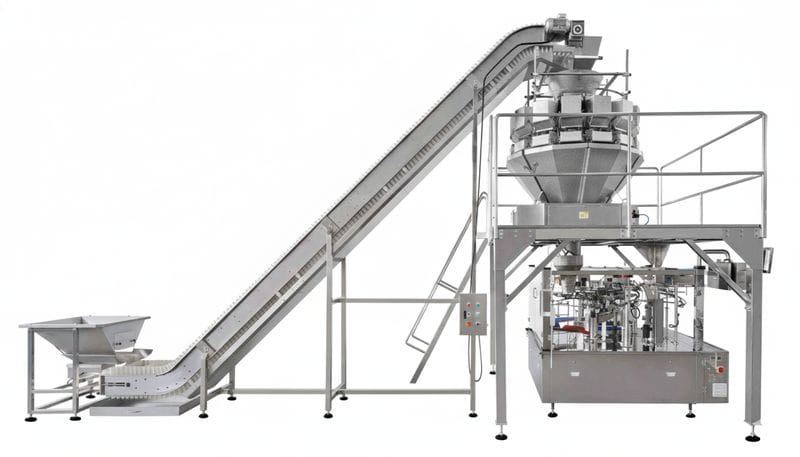
Technical Hook: The Paradox of Performance at the End of the Line
Today's manufacturing plants, especially in the FMCG, food and pharmaceutical sectors, are undergoing an unprecedented digital transformation. Investments in advanced ERP systems, predictive maintenance and robotic process nests have become standard. However, in many cases, production managers are encountering a phenomenon we laboriously call the "End of Line Paradox." It consists in the fact that despite having ultra-efficient batch preparation or mixing systems, the overall throughput of the plant is drastically reduced by the packaging section. Comprehensive integration of industrial systems is the key to solving this problem.
The bottleneck at the End-of-Line stage is often due to the lack of synchronization between the flexible process and the rigid mechanical structure of packaging machines. Increasing product personalization and short production runs make traditional packaging machines, which require lengthy changeovers and precise manual settings, a technological ballast. At SK Engineering, we design systems so that the end of the line is not just a "receiver" of the product, but an intelligent, adaptive link supporting the dynamics of the factory.
The technical aspects of this challenge are multidimensional. First, there is the mechanical inertia of older types of automatic machines, which cannot cope with dynamic changes in batch parameters. Second, the vertical integration (Vertical Integration) between the SCADA system and the execution layer of packaging machines is often residual. The lack of micromachining feedback flow prevents effective optimization of control algorithms. At SK Engineering, we eliminate these barriers by using an open control architecture based on standards such as EtherCAT or Profinet, which allows for full real-time synchronization of line speeds.
This problem is exacerbated by the increasing demands on packaging aesthetics. Modern formats, such as Doypack with zipper closure (Zipper) and Spout bags, require not only precise dispensing, but also perfect positioning and sealing of the film under high-speed conditions. Every second of downtime resulting from a blocked bag or leaking seal is a measurable financial loss, which can run into hundreds of thousands of zlotys annually. Optimizing the end of the line is therefore not just a matter of buying a new machine - it's a strategic approach to process engineering, where every sensor, every actuator and every paragraph of PLC code works toward a common economic outcome.
OEE 2.0: Going Beyond Simple Average
The Overall Equipment Effectiveness (OEE) indicator has been the gold standard for assessing production efficiency for years. However, in the context of End-of-Line packaging, a simple OEE calculation can sometimes be misleading. The traditional approach often masks micro-stops, which last a few seconds at a time, but occur hundreds of times during a shift. At SK Engineering, we promote an "OEE 2.0" approach, where data analysis takes place in real time, with precise diagnostics of each machine component. Thanks to IIoT (Industrial Internet of Things) class systems, any anomaly in the operation of a servo drive or pressure drop in a pneumatic system is immediately reported to a central database.
Availability in packaging is all about the speed of changeovers (SMED - Single Minute Exchange of Die). Modern Doypack rotary machines must allow intuitive format changes without the use of specialized tools (tool-less changeover). Every minute saved on adjusting grippers or setting guide widths translates directly into increased machine availability. In our designs, we focus on modularity, which allows the machine to be instantly adapted to new types of bags - from small sachets to large economy packs. RFID systems built into interchangeable format parts automatically verify correct assembly, eliminating human error during changeovers.
Efficiency in packaging is not only the number of pouches per minute (ppm). It is primarily the stability of this speed under varying conditions. SKE series machines are designed to maintain the declared parameters even with fluctuations in film characteristics or changes in the viscosity of the product being dispensed. The key here is the precise synchronization of the drive frame with the dispensing system. If the bag conveyor does not "talk" to the multi-head weigher in microseconds, time and product are lost. Advanced "Phase Matching" features in the motion controllers allow the gripper's opening torque to be dynamically adjusted to the physical position of the product drop, eliminating the risk of contamination of the sealing zone.
Quality in packaging is a critical section. A reject (waste) of 1-2% may seem acceptable, but on an industrial scale it means thousands of pieces of damaged products and a waste of expensive laminates. OEE 2.0 systems on SK Engineering machines monitor sealing parameters (temperature, time, pressure) for each individual bag. We use high-resolution thermal imaging cameras for online inspection of seals. This allows us to detect a downward trend in quality even before a batch of defective products is created. This is the technical excellence that builds real ROI, turning dry statistics into measurable net profit for the plant.
OEE in Doypack consists of three key factors:
- Availability (Availability): The ratio of time scheduled for production to actual work. In the case of Doypacks, changeover times and microstepping are key here.
- Performance (Performance): Comparison of the actual packing speed with the maximum (design) speed of the machine.
- Quality (Quality): Percentage of correctly packaged and tightly sealed bags that do not require rejection or improvement.
Scientific Deep Dive: Film Dynamics and Intelligent Algorithms (ResearchGate 2025)
One of the most fascinating aspects of modern packaging is the physics of flexible laminates. According to the latest research published in 2025 (on ResearchGate and arXiv, among others), classical methods of steady-state control in sealing sections are giving way to adaptive machine learning (ML) algorithms. Why is this important for machine engineering? Because packaging film is a heterogeneous material - its stretch, coefficient of friction (COF) and thermal characteristics can vary even within the same production roll.
Traditional machines maintain a constant temperature of the welding jaws. However, at high speeds (above 60 ppm), thermal inertia and the phenomenon of selective cooling of the jaws by the passing film become a problem that cannot be solved by ordinary PID loops. ML algorithms in SK Engineering machines collect data from infrared sensors, strain gauges and power control modules, dynamically adjusting parameters in fractions of a second. The system "feels" the resistance of the material and adjusts the clamping force to eliminate the risk of burning the film or creating leaks at the string (Zipper), where the thickness of the material is many times greater than in the rest of the bag.
Another breakthrough is web tension control (Web Tension Control). Uneven film guidance on VFFS or rotary Doypack machines leads to wrinkles and print offsets relative to the photo eye. The use of intelligent servo drives with Active Slack Compensation, integrated with the vision system, allows the perfect geometry of the bag to be maintained. As indicated by scientific studies in early 2025, precise control of film tension allows the use of thinner laminates (downgauging), which reduces unit material costs by about 15-20% while maintaining the same structural strength of the packaging. This is a key element of the company's sustainability strategy (ESG).
We cannot overlook the aspect of precise dispensing and hydrodynamic stabilization of the product. In the case of liquid products, the problem is "splashing" (splashing) when filling quickly, which inevitably contaminates the sealing zone and makes it impossible to achieve vacuum or inert gas (MAP - Modified Atmosphere Packaging). Integration of vision systems with dispenser drives allows the use of so-called "electronic cam-controlled pumps." An algorithm optimizes the velocity profile of the piston in the S-Curve system, allowing maximum flow in the middle phase of dispensing while gently landing the stream at the bottom of the bag. This is pure fluid physics harnessed to work in extremely harsh industrial environments.
Robust Architecture: the Role of SolidWorks and FEA in the HEC
The basis for the reliability of any special machine is its backbone. At SK Engineering, we do not consider compromising on structural rigidity and component durability. Every rotating machine design undergoes rigorous testing in the latest SolidWorks 2025 environment using advanced FEA (Finite Element Method) calculations. Why is this so important? A rotary machine operating with a heavy load (e.g., filling 2-kilogram bags at 80 ppm) generates powerful dynamic forces, bending moments and high-frequency vibrations. Advanced FEA calculations allow us to identify stress accumulation points.
FEA simulations allow us to identify stress accumulation points and potential resonances of the structure even before the first sheet of steel is cut on the laser. Optimization of the frame's topology allows for maximum stiffness while reducing the weight of moving parts by about 25%. Lighter grippers and mechanical arms made of special aluminum alloys or carbon composites (where extreme acceleration is required) mean less inertia. This in turn allows the use of smaller servo motors, which reduces energy consumption and extends bearing life.
We also create full Digital Twins (Digital Twins) of our systems in the SolidWorks environment. SK Engineering's Digital Twin is not just a 3D model; it's a virtual representation of the machine's behavior, taking into account the kinematics, all movement resistances, electrical parameters of the drives and the complete PLC control logic. This allows us to carry out so-called "Virtual Commissioning" - to test the operation of the entire line in virtual conditions even before it is physically assembled. Such a procedure eliminates the risk of mechanical collisions and allows us to optimize the motion trajectory of the grippers, which reduces the time of actual commissioning at the customer's site by up to 40-50%.
SK Engineering also pays attention to details, such as advanced hygienic design (Sanitary Design). In the food and pharmaceutical industry, every machine surface must be easy to decontaminate and resistant to aggressive cleaning agents (CIP - Clean In Place). We use only AISI 304 or 316L stainless steel, eliminating so-called "dead zones" (shadow areas) where biotope could accumulate. Each weld is polished to a roughness of Ra < 0.8 µm, and all shields and chokes are analyzed for compliance with stringent EHEDG standards and FDA approvals. For us, engineering reliability is not just a technical parameter, it is the foundation of end consumer safety.
Multi-format Capability: From Liquids to Granules
One of the greatest advantages of the Rotary Pouch Machines (Rotary Pouch Machines) designed by SK Engineering is their unparalleled versatility on the market. Our systems can handle a wide range of packaging formats: classic Doypack, Zipper (string closure), Spout (screw-in or push-in stopper), Flat (flat), Gusset (side gusset) or 4-side seal bags. Importantly, the same machines can be the basis for articles with extremely different physicochemical characteristics - from rare liquids and aerosols, through thick sauces, lubricants and gels, to granules, powders, vegetables, fruits and even assembly components for the automotive industry.
The key to this versatility is a modular dispensing system that can be replaced or expanded as the customer's business grows. The rotary machine serves as an intelligent conveyor and capping module that integrates as a "plug and play" standard:
- Multihead Weighers: Used for precise, ultra-fast portioning of bulk products, frozen foods or irregularly shaped items.
- Auger Fillers: Equipped with dust collection systems and torque control for dusty pharmaceutical and chemical powders.
- Piston/Mass Flow Fillers: For liquid products, often equipped with heating systems or agitators in hoppers to maintain a constant viscosity (such as when packaging honey or industrial pastes).
Integrating these disparate systems into one cohesive line is SK Engineering's domain as an experienced industrial systems integrator. By providing turnkey solutions, we take full responsibility for the "interface layer" (interface layer). This means that the customer does not have to worry about communication between the dispenser and the packaging machine or synchronization of conveyors. Full control over the software (in-house PLC/HMI development team) allows us to implement advanced functions such as "No Pouch - No Fill," which drastically reduces product loss in case of a temporary lack of packages in the tray.
Modern manufacturing demands flexibility at the SMED (Single Minute Exchange of Die) level. Our gripper adjustment mechanisms are equipped with digital position indicators and preprogrammed recipes in the HMI. The operator, when selecting a product from a list, is given clear instructions on the required manual adjustments (if necessary) or the system automatically positions the frame servo drives. As a result, the actual changeover time from 100 ml to 1000 ml format closes in less than 15 minutes. It is format flexibility, supported by robust mechanics, that builds our customers' competitive advantage in the dynamic FMCG market.
Engineering as the Foundation of ROI
Investing in advanced End-of-Line packaging systems is not just a capital expenditure (CAPEX); it's a strategic move to dramatically optimize operating costs (OPEX) over the long term. Choosing engineering solutions from SK Engineering means betting on a solid engineering foundation that pays off through years of trouble-free 24/7 operation. Process reliability, high OEE rates in excess of 85%, and full compliance with the latest Machinery Directive guidelines and rigorous CE certification is a standard we never deviate from.
Through extensive use of advanced FEA simulations, precision modeling in SolidWorks 2025, and implementation of adaptive Industry 4.0 technologies, we deliver machines that not only meet today's standards, but are technically ready for the challenges of the coming decade. By understanding process physics, product rheology and the dynamics of today's supply chains, we help our customers turn legacy bottlenecks at the end of the line into powerful engines of productivity growth and profitability for the entire manufacturing plant.
SK Engineering is not just a machine supplier - it is a technology partner. We are a team of integrators who analyze real production problems "from the shop floor" and turn them into reliable mechanical and software solutions. From single robotic stations to complex, fully automated packaging lines with capacities in the millions of cycles per year, our approach is always based on hard data, measurable parameters and engineering passion. Because in the unforgiving world of modern industry, only what is designed with mathematical precision and a passion for excellence has a chance to not only survive, but to set new standards.
Advanced Control and System Architecture (PLC & HMI)
At the heart of every SK Engineering machine beats an advanced control system, optimized for the extreme computing loads of Industry 4.0. We use the latest PLC (Programmable Logic Controller) units from world-renowned suppliers such as Siemens (S7-1500 family) and Rockwell Automation (ControlLogix series), which guarantees ease of service and availability of spare parts on every continent.
SKE's control architecture is based on intelligent decentralization. This means that critical motion control loops (Motion Control) are implemented directly in the intelligent servo drives, which relieves the load on the main CPU and allows for microsecond-level response times. Communication within the machine is via redundant real-time networks, eliminating the risk of electromagnetic interference (EMI), so common in heavy-duty environments.
The HMI (Human-Machine Interface) on SKE machines is the result of hundreds of hours of operator observation. We use high resolution multi-touch panels that offer not only process visualization, but full trend analytics. The operator not only sees the "green light," but has access to dynamic graphs of power consumption, sealing temperature distribution and product loss statistics. Advanced recipe management systems allow thousands of settings to be stored securely, protected by a multi-level authorization system (compliant with 21 CFR Part 11 for the pharma industry).
Aspects of Safety and Compliance (ISO 13849-1:2023)
In the context of line-end automation, the crucial role of functional safety cannot be overlooked. All SK Engineering systems are designed in strict compliance with the latest revision of ISO 13849-1:2023. This means that every safety function (Safety Function) - from emergency stops (E-Stop) to light curtains to safe speed limit systems (SLS) - undergoes a rigorous procedure to determine and verify the required level of safety assurance (PLr).
The new requirements of the 2023 standard place special emphasis on software security (Special Requirements for Safety-Related Application Software). At SKE, we use certified safety drivers and software libraries that eliminate the risk of systematic errors. Each of our machines comes with complete technical documentation, risk analysis and EU declaration of conformity, giving our customers legal and operational certainty in the event of inspections or external audits. Operator safety is as important to us as machine performance - these two parameters must go hand in hand. Our guards are designed to provide maximum visibility of the process without compromising on protection.
Predictive Maintenance in 2026.
As we enter 2026, Predictive Maintenance, driven by edge data analysis (Edge Computing), is becoming standard in our lines. By analyzing bearing vibration using FFT (Fast Fourier Transform) algorithms and continuously monitoring the current profile of servo motors in all axes of motion, we are able to detect the first signs of component micro-wear weeks before a real failure occurs.
The HMI system displays a clear message to the operator or maintenance staff when, for example, a specific linear guide needs to be lubricated or a drive belt in a gripper section needs to be replaced, while providing the exact part number and a link to a video manual or AR (Augmented Reality) model. This proactive service strategy drastically reduces unplanned downtime (Unplanned Downtime). Combined with our Secure Remote Access over VPN (Secure Remote Access over VPN) system, our engineers can perform in-depth online diagnostics and help solve a complex programming problem without having to physically come to the plant during the first phase of the request, reducing service costs by more than 60%.
Materials Engineering and Sensors: Eyes and Ears of the Machine
The uniqueness of SK Engineering machines also stems from the selection of premium sensory components. Each rotary machine is equipped with a number of advanced sensors that act as the "nervous system" of the system. We use, among others:
- Precision Laser Sensors: For package thickness measurement and double-bag detection with an accuracy of 5 microns.
- Ultrasonic Level Sensors: In batching trays, resistant to dusting and changes in batch temperature.
- High IP69K Inductive Sensors: For monitoring the position of the mechanical frame under intensive chemical cleaning conditions.
In the realm of materials engineering, we use specialized coatings for sealing jaws (e.g., nanoceramic anti-stick layers) that prevent film sticking even with extremely short heating cycles. All parts in contact with the product are finished to the highest standards of roughness, which minimizes frictional forces and facilitates laminate flow. Every component of the machine, from the smallest screw to the massive base plate, is an integral part of a precision mechanism designed to run trouble-free for decades.
FAQ - Frequently Asked Technical Questions:
Do SKE rotary machines handle biodegradable film and monomaterials (PP/PE)?
Yes, absolutely. We understand the challenges of eco-friendly alternatives to traditional PET/PE laminates. Using advanced temperature control systems with 0.1°C accuracy and adaptive, programmable jaw pressure (Active Pressure Control), our machines are fully compatible with bio-degradable films and monomaterials that require an extremely narrow process window during sealing and forming.
What is the typical return-on-investment (ROI) time for a comprehensive SKE line automation?
Depending on the specific industry, number of work shifts and raw material costs, the typical ROI (Break-Even Point) ranges from 14 to 28 months. The ROI comes not only from reduced labor costs, but more importantly from a significant reduction in rejects (Waste Reduction), savings of expensive laminates on ultra-fast changeovers, and a dramatic drop in energy costs due to optimization of servo drives and power recovery systems.
Do you offer support for integration with overarching MES/ERP/WMS systems?
Yes. All of our PLCs come standard with OPC UA servers and support protocols such as MQTT, allowing instant and secure communication with any modern MES, ERP or WMS system. We provide ready-made data maps (Data Blocks), which allows for full traceability of a production batch (Full Traceability) and real-time performance reporting directly to the cloud or customer analytical systems.
What are the media requirements (current, air) for a 50-80 ppm rotary machine?
Each project is individual, but as standard our machines are designed to be highly energy efficient (Green Architecture). We use servo motor braking energy recovery systems (DC bus sharing). Detailed compressed air requirements are optimized through the use of economical pneumatic nozzles and highly dynamic valves, reducing the consumption of the medium by about 30-40% compared to standard pneumatic designs on the market. The machines are suitable for operation on networks with low current stability thanks to built-in buffer power supply modules and harmonic filters.